ATELIER FLÖRL
MATTER, FORM, PRESENCE:
The Sculptural Legacy of Hubert J. Flörl


ATELIER FLÖRL (@atelierfloerl) is a contemporary cultural framework dedicated to the sculptural legacy of Austrian artist Hubert J. Flörl, connecting his work with architecture, design, material culture, and new forms of editorial storytelling.
At the center of Flörl’s practice is the human figure — reduced, elongated, opened, and transformed through bronze, marble, and glass. Rather than functioning solely as representation, the figure becomes a vessel for movement, stillness, spirituality, and human presence.
Across intimate sculptures and monumental works, material and form remain inseparable. Mass is balanced by openness; weight by movement; physical presence by an almost immaterial sense of elevation.
Today, Atelier Flörl creates a contemporary framework through which this body of work can be encountered anew. The sculptures remain unchanged. What evolves is the context around them — and with it, the possibilities for new dialogues between sculpture, architecture, material, space, and contemporary culture.

Madonna - 2011 (Bronze)
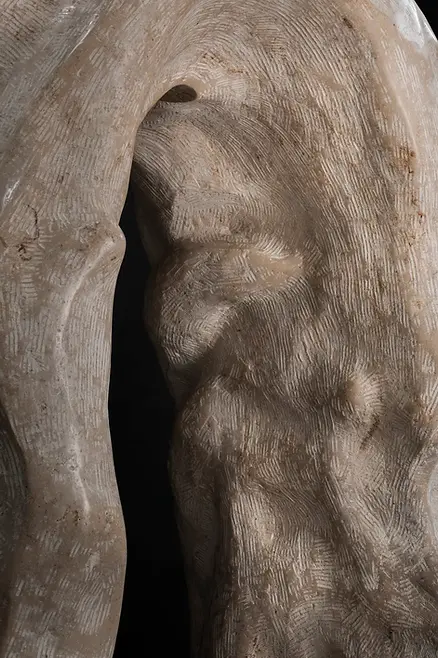
Lebensquell - 2014 (South African marble)

Moses - 2021 (Murano glass)
Marble, bronze, and glass become vessels for presence — shifting between weight and lightness, human form and abstraction, stillness and movement.
ABOUT
BETWEEN MATTER AND PRESENCE
Hubert J. Flörl developed a sculptural language grounded in a profound understanding of material, proportion, and the human figure. Working primarily in bronze and marble, and later extending his investigations into glass, he approached material not simply as surface or substance, but as an active component of expression.
His figures frequently exist between recognition and abstraction. Bodies stretch, merge, open, and rise; solid volumes are interrupted by voids; gestures are reduced until posture itself becomes meaning. Through this economy of form, Flörl created sculptures capable of conveying protection, fragility, movement, devotion, tension, and stillness without relying on narrative excess.
There is also an architectural quality to his work. Many sculptures were conceived in direct relationship with specific environments — sacred spaces, public sites, architectural commissions, and monumental settings. Scale therefore becomes more than dimension: it determines how the body encounters the work and how sculpture reorganizes the space around it.
Spirituality runs quietly throughout this practice. It appears explicitly within Flörl’s sacred works, but also more subtly through verticality, gesture, openness, and the recurring movement of forms toward elevation.
Whether carved from monumental blocks of stone or condensed into intimate bronze figures, his sculptures repeatedly return to a fundamental question: how can material acquire presence?


Mother Earth, 2008.Carved from a single block of Carrara marble weighing over 36 tonnes, the monumental sculpture emerged through more than 2,000 hours of work.
WORKS
I.ORIGIN & ELEMENT
MOTHER EARTH / LEBENSQUELL / WASSERLAUF
Across Flörl’s marble works, nature is rarely represented literally. Instead, elemental forces — earth, water, growth, movement — are translated into sculptural rhythms.
Stone appears simultaneously ancient and alive: something carrying geological time while remaining capable of movement. Through reduction and flowing contours, marble becomes a language through which origin, continuity, and transformation can be made visible.
MOTHER EARTH — 2008
Carved from a single monumental block of Carrara marble, Mother Earth stands among Hubert J. Flörl’s most ambitious works.
The sculpture transforms extraordinary physical mass into an ascending, fluid presence. Rather than imposing a predetermined geometry upon the stone, the form appears to emerge from within it — preserving something of the original energy and vertical force of the material.
Mass and movement remain suspended in tension. Monumentality is present, yet the sculpture resists heaviness. Its surface rises, opens, and folds upward, transforming stone into an image of origin, continuity, and becoming.
LEBENSQUELL— undated
Lebensquell approaches water not through representation, but through movement. Rising from the solidity of marble, its curved form evokes a spring emerging from the depths of the earth — an elemental force unfolding upward.
Within the work, stone appears almost fluid. Weight gives way to movement, while the ascending contour suggests water, growth, and continuous transformation.
Rooted in an Alpine understanding of landscape, Lebensquell connects rock and water as interconnected sources of life. The sculpture becomes an image of origin and renewal: a form in which the permanence of stone carries the possibility of continuous becoming.

Lebensquell - undated (Marble) 12 x 32 x 122

Lebensquell - undated (Marble) 12 x 25 x 105
WASSERLAUF — undated
In Wasserlauf, movement becomes the subject of sculpture. Marble extends horizontally through space in a continuous, rhythmic line, recalling the path of water as it moves through a landscape.
There is no emphatic beginning or end. Instead, the form unfolds as a continuum, shifting gently in direction while retaining an underlying sense of calm.
Through this reduction, Flörl transforms the flow of water into a meditation on time and continuity. Permanence and change coexist within the same material: stone holds the movement of something that, by its nature, never remains still.

Wasserlauf - undated (Marble) 119 x 10 x 10

Wasserlauf - undated (Marble) 78 x 24.5 x 11.5

Wasserlauf - undated (Marble) 75 x 12 x 22
II. THE HUMAN FIGURE
JEDERMANN / FAMILIE / MUTTER MIT KIND
The human figure remains one of the central structures within Flörl’s sculptural language.
Yet anatomy is rarely the final subject. Bodies are elongated, compressed, intertwined, or reduced until gesture carries the emotional weight of the work.
Through these transformations, the figure becomes relational: mother and child, individual and family, vulnerability and protection, human presence and transcendence. What remains after reduction is not less human, but perhaps more universal.
JEDERMANN — 2005
Jedermann emerged from Hubert J. Flörl’s encounter with Hugo von Hofmannsthal’s celebrated play at the Salzburg Festival in 2005, where he saw Tobias Moretti perform the role of the Devil.
Rather than translating a specific character into sculpture, Flörl absorbed the existential tensions of the work — life and death, temptation and transience — and transformed them through the human figure.
The resulting bronze stretches the body into an elongated, almost weightless presence. Movement and fragility coexist with tension, turning the figure into something less descriptive than psychological: a body suspended between physical presence and the awareness of its own impermanence.
MUTTER MIT KIND — 2002
Mutter mit Kind reduces one of sculpture’s most enduring subjects to an intimate encounter between two bodies.
Mother and child are condensed into a single organic composition. Flowing curves envelop the smaller figure, dissolving the distinction between individual bodies and emphasizing instead the physical gesture of holding and being held.
Through this formal economy, Flörl moves beyond narrative representation toward something elemental. The sculpture becomes an expression of protection and trust — a quiet image of closeness in which care is communicated through the structure of the form itself.
FAMILIE — undated
Familie approaches the family not as a collection of individual figures, but as an interconnected sculptural body.
Abstracted forms grow into, around, and alongside one another. Each remains perceptible, yet none exists independently: bodies support and surround each other while the spaces between them become as significant as the solid forms themselves.
The upward movement suggests growth and continuity, while the enclosing structure creates a sense of protection. Through this balance between individuality and interdependence, Familie becomes a meditation on belonging — different lives held together through proximity, care, and shared experience.


Mutter mit Kind- 2002 (Bronze) 38 x 11 x 18
Jedermann- 2005 (Bronze) 38 x 47 x 115

Familie- undated (Bronze) 10 x 17 x 44
III. SPIRITUAL PRESENCE
DREIEINIGKEITSKREUZ / IM SCHUTZ DES ENGELS / MADONNA
Spirituality in Flörl’s work is expressed not only through religious iconography, but through posture, verticality, openness, and the relationship between solid form and empty space.
Figures rise, shelter, intersect, and dissolve into one another. The sacred is therefore not treated as an illustration, but as a condition of presence — something suggested through balance, vulnerability, elevation, and silence.
DREIEINIGKEITSKREUZ — 1998
In Dreieinigkeitskreuz, Flörl reconsiders the traditional form of the Christian cross through an open and highly reduced sculptural composition.
Three abstracted figures interconnect to form a single structure, referring to the unity of Father, Son, and Holy Spirit. Body and cross are no longer separate elements: they merge, while the voids between them introduce lightness and movement into the bronze.
The result transforms religious symbolism into spatial experience. Solidity is balanced by openness, individuality by unity, and the physical presence of the material by the suggestion of something immaterial.
IM SCHUTZ DES ENGELS — 2002
Im Schutz des Engels is structured around an encounter between vulnerability and protection.
A reduced human figure stands beside a larger, sweeping form that rises above and around it. Without explicitly describing an angel, Flörl allows the surrounding gesture to communicate its presence: something unseen made perceptible through shelter.
The relationship between the two forms gives the sculpture its emotional clarity. Protection is expressed spatially rather than narratively — through proximity, enclosure, and the quiet tension between a vulnerable body and the presence that surrounds it.
MADONNA — 2011
In Madonna, a traditional sacred motif is transformed through radical formal reduction. Rising to more than two meters, the bronze appears almost as a continuous vertical gesture, its elongated form moving upward before gradually revealing the presence of mother and child.
The figures are suggested rather than described. What remains is their relationship: closeness, protection, and the intimate gesture of one body sheltering another.
Its exceptional verticality gives Madonna a presence that is simultaneously fragile and monumental. Suspended between earth and transcendence, the sculpture transforms maternal care into an image of devotion, shelter, and quiet strength.

Dreieinigkeitskreuz - 1998 (Bronze) 13 x 31 x 53

Im Schutz des Engels - 2002 (Bronze) 20 x 13 x 49

Madonna- 2011 (Bronze) 17 x 18 x 217
IV. MYTH, NATURE & MOVEMENT
SALIGE / FEE / AUFSTEIGENDES PFERD/BULLE & BÄR
Elsewhere, Flörl’s figures move toward mythology, nature, and states of transformation.
Human, animal, and organic forms begin to overlap. Bodies appear to grow from their surroundings or momentarily emerge from continuous lines of movement.
These works reveal another dimension of Flörl’s practice: sculpture not as a fixed body, but as captured energy — a form held at the threshold between becoming and disappearance.
SALIGE — 2009
Salige draws upon the mythology and folklore of the Alpine region, where the mysterious female figure is understood as a guardian of mountains, forests, and the invisible forces of nature.
In Flörl’s interpretation, the body seems to emerge directly from an organic structure. Human figure, tree, and landscape begin to merge, making it difficult to determine where one ends and another begins.
The sculpture occupies a threshold between physical body and mythical apparition. Nature is no longer simply the environment surrounding the figure; it becomes part of the figure itself, suggesting an older and more elemental relationship between human presence and landscape.
FEE — 1997
Fee exists between figure and apparition. The female body is reduced to an open, continuous gesture, appearing less like a solid presence than a form momentarily emerging into view.
A large void at the center interrupts the bronze and gives the sculpture an unexpected sense of transparency. Solid material begins to suggest air, wind, and movement; physical weight is countered by openness.
Through this tension, Flörl transforms the figure into something elusive. Fee inhabits the boundary between nature and imagination, material presence and disappearance — as though the sculpture were capturing a fleeting form before it dissolves again.

Salige - 2009 (Bronze) 40 x 60 x 200


Fee -1997 (Bronze) 10 x 10 x 37
AUFSTEIGENDES PFERD — 1996
In Madonna, a traditional sacred motif is transformed through radical formal reduction. Rising to more than two meters, the bronze appears almost as a continuous vertical gesture, its elongated form moving upward before gradually revealing the presence of mother and child.
The figures are suggested rather than described. What remains is their relationship: closeness, protection, and the intimate gesture of one body sheltering another.
Its exceptional verticality gives Madonna a presence that is simultaneously fragile and monumental. Suspended between earth and transcendence, the sculpture transforms maternal care into an image of devotion, shelter, and quiet strength.
BULLE & BÄR — 1996
Bulle & Bär transforms the familiar symbols of financial markets into a compact sculptural study of opposing forces.
Rather than depicting the animals naturalistically, Flörl intertwines their abstracted bodies within a tightly connected composition. Growth and decline, confidence and caution, momentum and resistance appear not as separate states, but as forces continuously acting upon one another.
The circular structure reinforces this sense of recurrence. Neither force can exist independently of the other; each contains the possibility of reversal. Through their physical entanglement, bull and bear become an image of a system defined by perpetual tension, movement, and change.

Aufsteigendes Pferd - 1996 (Bronze) 41 x 27 x 50

Bulle & Bär - 1996 (Bronze) 50 x 50 x 53
V. MATERIAL TRANSFORMED: FLÖRL × SEGUSO
MOSES / DONNA DI NEBBIA
In 2021, Flörl’s sculptural language entered into dialogue with the centuries-old tradition of Murano glass.
Developed in collaboration with Gino Seguso and presented at the Museum Archimede Seguso on Murano, Moses and Donna di Nebbia translate the artist’s investigation of the figure into an entirely different material condition.
Where bronze emphasizes density and marble carries geological weight, glass introduces transparency. Light moves through the sculptures, dissolving their boundaries and transforming physical mass into an interplay of reflection, movement, and apparent weightlessness.
The collaboration reveals the continuity of Flörl’s language across materials: the figure remains present, but its relationship with space changes completely.

DONNA DI NEBBIA - 2021 (Murano glass) 51 × 16.5 × 61 cm


MOSES - 2021 (Murano glass) 16.5 × 16.5 × 42 cm

THE ATELIER
MAXIMILIAN FLÖRL & CHRISTIANE FLÖRL
Maximilian Flörl grew up within Hubert J. Flörl’s atelier, surrounded by clay models, marble dust, bronze casts, and works in different stages of completion. Following the artist’s passing in 2023, he began developing Atelier Flörl as a contemporary structure through which the archive and sculptural legacy could be preserved and repositioned.
Working across archive development, editorial direction, digital presence, and cultural strategy, Maximilian builds the framework around the existing body of work, connecting it with contemporary architecture, design, material culture, and visual communication.
Alongside him, Christiane Flörl brings more than two decades of experience across culture, hospitality, international relations, and the artist’s professional history. Having accompanied Hubert J. Flörl through exhibitions, commissions, and cultural projects, her role provides continuity and an intimate understanding of the relationships and histories surrounding the work.
Together, they position Atelier Flörl not simply as an archive, but as an active cultural platform for the continued life of the artist’s legacy.


BIOGRAPHY
HUBERT J. FLÖRL
Hubert Josef Flörl (1960–2023) was an Austrian sculptor whose practice encompassed monumental sculpture, sacred art, portraiture, and architectural commissions.
He studied sculpture at the Academy of Fine Arts Vienna from 1982 to 1987 under Ferdinand Welz and Franz Xaver Ölzant, and during his studies received a scholarship for a six-month research stay in Cairo focused on pharaonic art.
Working as an independent artist from 1987 onwards, Flörl developed an extensive body of work primarily in bronze and marble, later also exploring glass. His sculptures were presented internationally and commissioned for public, sacred, and architectural contexts across Europe.
His work was exhibited at institutions and locations including the European Parliament in Brussels and Strasbourg, the Museum of Fine Arts in Malta, and cultural contexts in Rome, Jerusalem, and New Orleans.
Flörl received the Theodor Körner Prize twice and, in 2014, was awarded the professional title of Professor by the Republic of Austria.
SCULPTURE DOES NOT END WITH FORM.
IT CONTINUES THROUGH THE WAY WE ENCOUNTER IT.


ATELIER FLÖRL, Tyrol / Vienna
