

ARTTYCO DIALOGUES
Mark Dale, CEO & Creative Director of W1 Curates, explores a new territory for contemporary art, where sound, space, and experience redefine its encounter.
INTERVIEWS | April 09, 2026
EPISODE #2: MARK DALE
1. W1 Curates has consistently placed art in environments far removed from traditional institutions. At what point did this shift toward nightlife and large-scale cultural spaces become a deliberate strategy?
M: The move wasn’t a sudden pivot but a gradual realisation. We became increasingly interested in where people actually engage with culture today. Traditional institutions remain vital, but they are no longer the sole context for meaningful encounters with art. Nightlife and large-scale venues offered something different an immediacy, a density of experience, and a more diverse audience. At a certain point, it became a deliberate strategy: to place ambitious contemporary art into spaces where it could be encountered unexpectedly, outside of the codes and expectations of the white cube.

Jeff Koons. W1 Curates x Counter Editions.
2. With projects like Hï Ibiza Ushuaia and [UNVRS], the audience scale is radically different from that of galleries or museums. How does this change the way you think about curating and selecting artists?
M: Working at this scale shifts the curatorial lens, it's not about simplifying, but amplifying how work communicates across different levels of engagement. We think about visibility, rhythm, and how art operates within high energy environments. The artists we work with don't dilute their practice, they expand it, while we ensure conceptual integrity remains intact.
At the same time, we hold every project to a blue chip gallery
standard, regardless of context.
Collaborating with Yann Pissenem and his team at The Night League, the company behind these venues, on this project allows us to work at a scale that shifts the curatorial lens, it's not about simplifying, but amplifying how work communicates across different levels of engagement. We think about visibility, rhythm, and how art operates within high energy environments.

[UNVRS]_Vhils.
3. The pairing of Michael Craig-Martin and Vhils brings together two very different practices — conceptual and urban, digital and physical. What was the thinking behind this dialogue?
M: The dialogue is built on contrast Michael Craig-Martin’s clarity and precision alongside Vhils’ material, process-driven approach. Together, they explore permanence and transformation, digital and physical languages.
In the context of UNVRS, Vhils felt instinctive. Carving directly into a stone façade aligned with the space’s connection to nature and its sense of surprise, making the work inseparable from the environment.
Alongside this, Michael Craig-Martin’s work unfolds as an immersive environment drawing on 20 years of imagery centred on musical instruments. His bold use of colour becomes dynamic, flooding the space with an ever shifting wash of light and energy.

Michael Craig-Martin interview.

VHILS x W1 x [UNVRS]
4. Vhils’ intervention at [UNVRS] transforms architecture into surface and narrative. How important is the idea of site-specificity within your broader programme?
M: Site specificity is central to our programme, particularly in projects like UNVRS. These are not neutral spaces; they come with their own histories, architectures, and energies. Artists like Vhils respond directly to these conditions, transforming walls into narratives that are inseparable from their context. We see site-specific work as a way of grounding contemporary art within lived environments making it more immediate, more relevant, and more embedded in its surroundings.

Michael Craig-Martin’s Music (2026) at Hï Ibiza, Spain. Artwork © Michael Craig-Martin
5. There is a strong sense that these works are not isolated pieces, but part of a larger cultural ecosystem. How do you approach building that continuity across different venues and cities?
M: We approach each project as part of a wider, interconnected ecosystem rather than a standalone intervention. This involves maintaining a consistent curatorial vision while allowing for local adaptation in each city or venue. Collaborations with artists and cultural leaders help create continuity across different contexts. Over time, these layers build a network of experiences that audiences can recognize and follow, even as the specifics evolve. It’s about creating a cultural thread that connects diverse spaces and communities.

[UNVRS]_Vhils

[UNVRS]_Vhils
6. To what extent do you see W1 Curates as contributing to a new model of cultural distribution one that sits somewhere between public art, entertainment, and institutional programming?
M: W1 Curates operates in a space that sits between public art, music, fashion and institutional programming but we see this not as a hybrid, but as a natural progression. Traditional boundaries between these categories are increasingly blurred. Our model embraces this fluidity, positioning art within everyday environments while maintaining curatorial rigor. In doing so, we hope to expand access and redefine how and where contemporary art can be encountered.

Mark Dale, CEO & Creative Director W1 Curates.

Andre Reisinger.
7. Ibiza has historically been a meeting point for music and global culture. What role do you see it playing now within the contemporary art landscape?
M: Ibiza has long been a crossroads of global culture, driven by music and a spirit of openness. Today, it offers a unique platform for contemporary art, particularly within three of the island’s most influential nightlife spaces, Hï Ibiza, Ushuaïa Ibiza and [UNVRS] ibiza . The island attracts a diverse, international audience already attuned to immersive and sensory-driven experiences. By introducing art into this context, we are not competing with Ibiza’s cultural identity but building upon it—adding another layer to its creative ecosystem. In this way, Ibiza becomes not just a destination for nightlife, but a site for meaningful artistic engagement that audiences encounter organically, often when they least expect it.
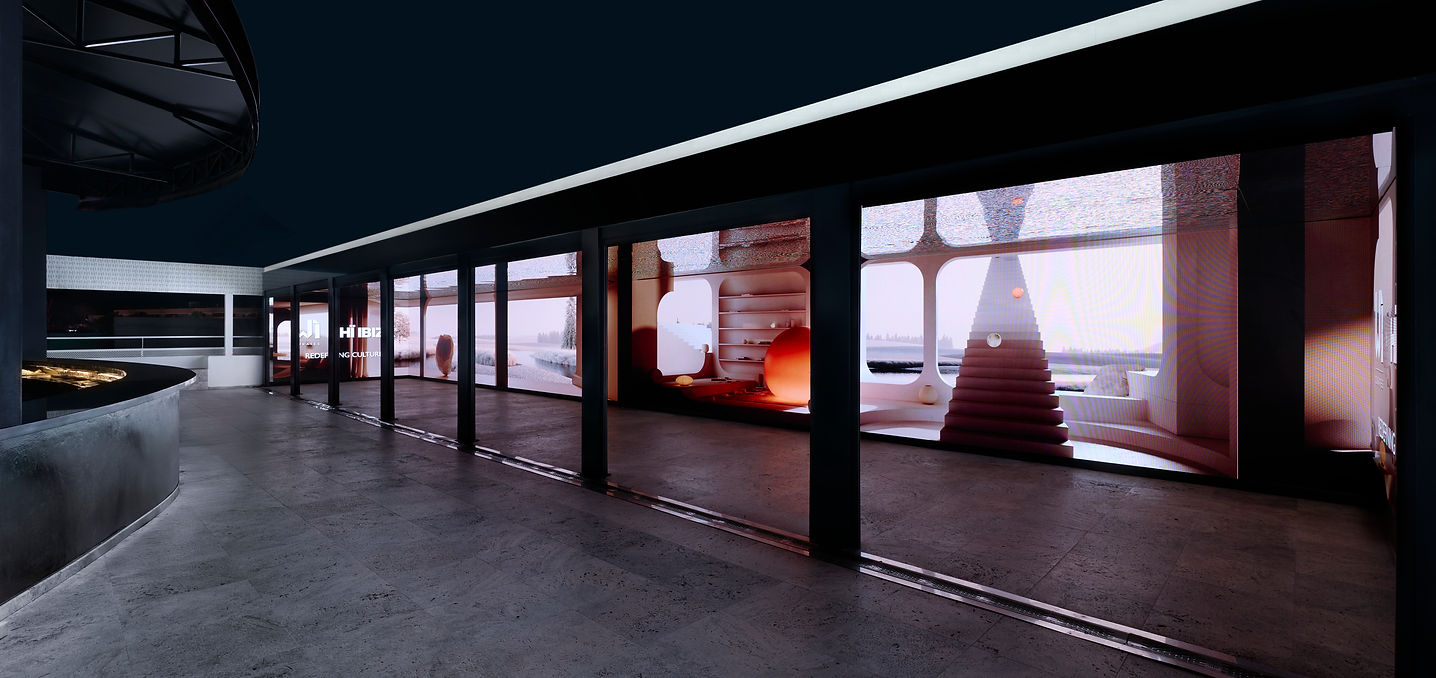
Hi Ibiza Sixnfive
8. Looking ahead, how do you imagine this model evolving over the next few years?
M: Looking ahead, we see this model continuing to expand both geographically and conceptually. There is growing interest in integrating art into non-traditional spaces, and we aim to deepen these collaborations while exploring new formats digital, performative, and architectural. At the same time, we remain committed to maintaining a strong curatorial identity, ensuring that as we scale, the work stays thoughtful and artist-led.
Ultimately, the goal is to build a sustainable, globally connected platform where art can exist beyond conventional frameworks supported by a collaborative community in which artists, partners, and audiences work together, enabling everyone involved to grow and achieve their shared ambitions.

W1 Curates x Gagosian, presents Meleko Mokgosi.

[UNVRS]
9. You have an art weekend planned to launch your project in ibiza. Can you tell us a bit about it and the artist involved ?
M: We’re launching an art weekender in Ibiza on the 8th and 9th of May, spanning Hï Ibiza Ushuaïa Ibiza and UNVRS bringing together audiences across three of the island’s most influential cultural spaces.
The programme brings together blue-chip artists, headline DJs, fashion brands, and technology led experiences, creating a fully immersive, cross-disciplinary environment. Artists already announced include David LaChapelle, Michael Craig-Martin , Ian Davenport, Vhils and pichiavo, with over 50 more to be revealed.
Rather than a traditional art event, the weekender unfolds as a continuous, fluid programme across all three venues designed for audiences to encounter art organically within Ibiza’s energy.
Ultimately, it presents a model where art, nightlife, fashion, and technology converge at scale, driven by collaboration and shared ambition. We’ve recently launched a new community app in partnership with The Night Leauge , the force behind Hi Ibiza,Ushuaia Ibiza, and [UNVRS] as a way of extending the experience beyond the physical spaces we operate in.

Mark Dale in Timber Street Studios

Hi Ibiza Ash Thorp.
10. You’ve just launched a new community app with the night league the force behind the three ibiza clubs your partnered with. Can you tell us a bit about it?
M: The app is designed as a digital layer to the programme connecting audiences, artists, and collaborators in a more direct and ongoing way. It offers access to exclusive content, artist insights, and real-time updates, while also creating a space for community interaction around the projects we’re building.
More broadly, it reflects our interest in building a connected ecosystem where physical and digital experiences work together, and where engagement doesn’t end when you leave the venue. It’s about giving our audience a way to stay plugged into the culture, wherever they are.

Michael Craig-Martin’s Music (2026) at Hï Ibiza, Spain. Artwork © Michael Craig-Martin

