

Nera Branca
Unstable Forms:
A Study of Matter, Transformation, and the Language of Change.

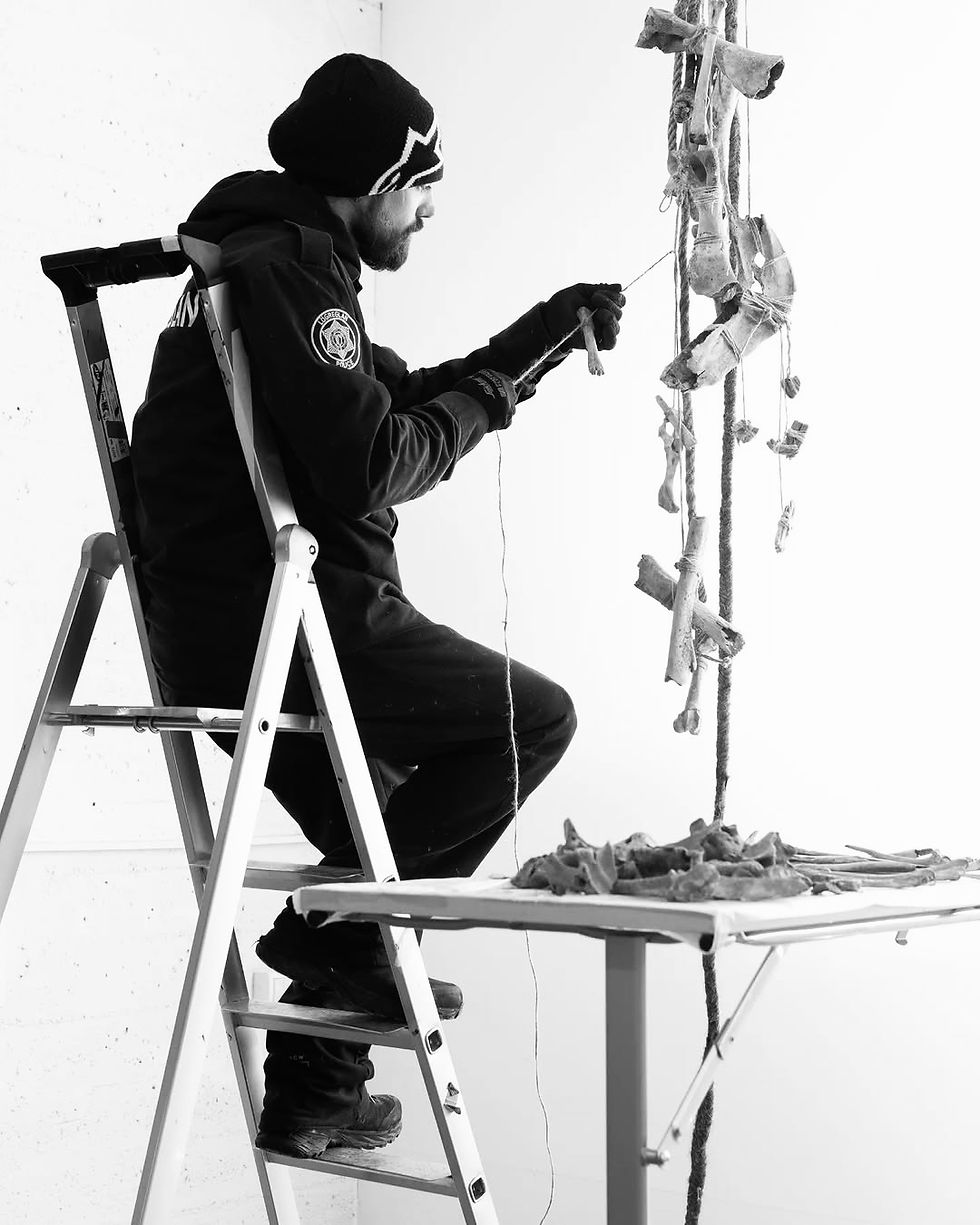


Forms in constant tension are not fixed bodies but sites of transformation, where matter fractures, mutates, and reveals its inner force.
Nera Branca’s practice unfolds within a territory where matter is never still. Bone, skin, ink, thread, wood, and found remains become carriers of transformation, holding together the tensions between wound and regeneration, decomposition and rebirth, violence and silence.
Across drawing, sculpture, and installation, Branca constructs beings, thresholds, and ritual presences that seem to emerge from a world both ancestral and posthuman. His forms do not illustrate nature. They appear to grow from it, as if shaped by erosion, survival, memory, and the hidden intelligence of organic life. What surfaces in his work is not the fixed image of a body, but the unstable moment in which matter is changing state.

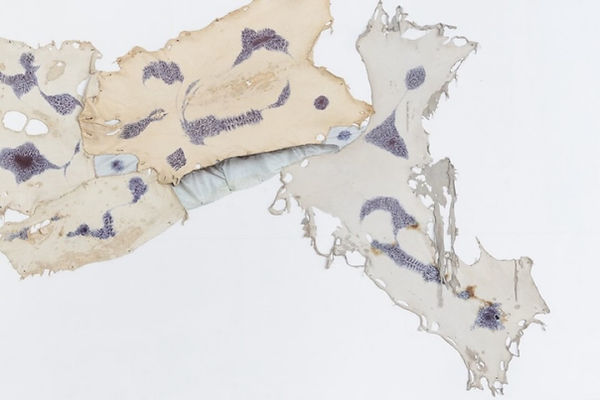
Arazzo di pelli I. Fragments of skin reassembled into a shifting surface. A landscape where trace, mark, and memory intertwine.
ABOUT
Nera Branca’s artistic language moves through the darker and more visceral dimensions of existence, where transformation is understood not as a symbolic idea, but as a physical and spiritual condition. His work repeatedly returns to the body as a mutable territory, one marked by fracture, deterioration, instinct, and renewal.
In his drawings, black ink opens spaces that feel at once anatomical, geological, and hallucinatory. Cavities, scars, knots, fibers, membranes, and branching structures appear in states of tension, as if suspended between emergence and collapse. These forms often suggest bark, bone, flesh, tunnels, nerves, or wounds, yet they resist stable identification. They remain in flux, positioned between the intimate and the primordial.
This same sensibility expands in his sculptural and installation practice, where Branca assembles wood, bones, skins, threads, and found materials into creature-like presences that evoke ritual, guardianship, and metamorphosis. These works do not simply occupy space. They seem to guard it, contaminate it, and reconfigure it, turning exhibition environments into sites of passage, instinct, and threshold experience.
His practice is deeply informed by the landscapes between which he lives and works, particularly Milan and Gressoney Saint Jean in the Aosta Valley, where forests, mountain paths, animal traces, and material recovery enter his work not as background, but as active forces. In more recent projects such as The Migration of Silent Creatures, this dialogue extends outward into new geographies, where migration, displacement, and the assembling of hybrid beings become part of a broader reflection on belonging, memory, and the unstable life of matter.


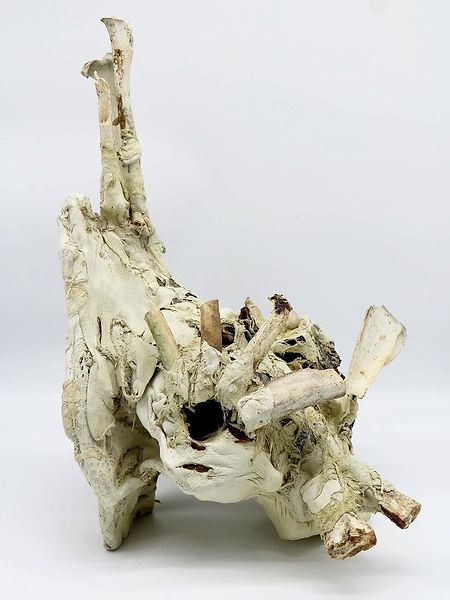
Guardiano del Supplizio. A silent guardian shaped from bone, skin, and memory. A body that holds the passage between violence and stillness.
WORKS
TANA DI VOLPE
A central body of work within Nera Branca’s practice, Tana di Volpe develops a visual language of cavities, scars, breaches, and dark internal architectures. These ink drawings evoke the den as both shelter and psychic chamber: a place of concealment, vulnerability, wisdom, and latent violence. The series suggests not only an image of refuge, but a form of consciousness built from rupture and survival.
ANDROMEDA
In Andromeda, Branca condenses her language into a more concentrated and almost emblematic form. The work appears suspended between celestial structure and corporeal mutation, opening a tension between the cosmic and the visceral. It reflects her ability to make abstraction feel simultaneously mythic and bodily.
PROLE ASTRALE
Prole Astrale extends Branca’s iconography toward a more generative and spectral field. The title already suggests offspring, propagation, and a movement beyond the strictly terrestrial. The work carries the sensation of a form still in the process of emerging, as if matter were attempting to invent a new anatomy.
FERITA N. 13
In Ferita N. 13, the idea of the wound becomes direct and distilled. The image functions not simply as a mark of injury, but as a concentrated site of force, where surface tension, pain, and transformation converge. It belongs to Branca’s broader investigation into rupture as a generative condition.
PORTATORE MECCANICO DELL’ALBA ROSSA
This work introduces a more explicitly sculptural and creature-based vocabulary. Constructed through assemblage and charged with ritual intensity, it appears as a bearer figure suspended between relic, machine, fetish, and survivor. The red skin-like surface, exposed hardware, and bone elements give it a ceremonial and apocalyptic presence.
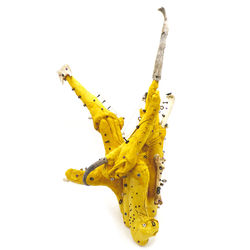
YELLOW KING
Yellow King continues this sculptural direction through a form that feels both archaic and unstable. Its verticality gives it the force of an idol or guardian, while its stitched, pierced, and hybrid body suggests a history of survival through violence, adaptation, and recomposition.
THE MIGRATION OF SILENT CREATURES
Developed in Reykjavík in 2025, this project marks a significant expansion of Branca’s practice. Built during a month-long stay in Iceland, it brought together drawings, bones, skins, ropes, and found materials into an installation inhabited by silent, hybrid presences. The project deepened her ongoing reflection on migration, not only as physical movement across territories, but as a condition of matter itself: the breaking down and reassembly of forms into new and often unsettling states.
 TANA DI VOLPE_3 ©Courtesy of the artist | 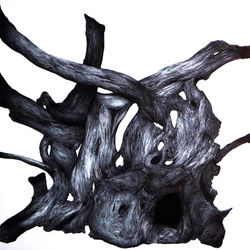 TANA DI VOLPE α ©Courtesy of the artist |  PROLE ASTRALE ©Courtesy of the artist |  TANA DI VOLPE_2 © |  TANA DI VOLPE ╬▒ ©Courtesy of the artist |
|---|---|---|---|---|
 PORTATORE DI PESTILENZA ©Courtesy of the artist |  TANA DI VOLPE MAGGIORE ©Courtesy of the artist |  ANDROMEDA ©Courtesy of the artist |  FERITA N. 13 ©Courtesy of the artist | 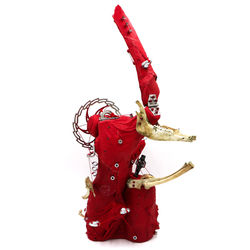 _PORTATORE MECCANICO DELL'ALBA ROSSA_1 ©Courtesy of the artist |
 YELLOW KING_©Courtesy of the artist |  _FOSSILE DIGERITORE ELEPHANTIDAE__©Courtesy of the artist |
BIO
Nera Branca is an Italian artist born in Milan in 1994. He lives and works between Milan and Gressoney Saint Jean, in the Aosta Valley.
His practice spans drawing, sculpture, and installation, and is grounded in a sustained investigation into decomposition, transformation, fracture, and the unstable life of matter. Working with ink, wood, skins, bones, thread, and recovered elements, he constructs visual and spatial vocabularies in which the organic, the ritual, and the hallucinatory converge.
Branca has developed a distinctive body of work through series such as Tana di Volpe, as well as recent installation projects including The Migration of Silent Creatures. His exhibitions include presentations in Italy and Iceland, and his work has been shown in institutional and independent contexts that foreground experimental contemporary practices.
SELECTED EXHIBITIONS
2025
The Migration of Silent Creatures — Solo exhibition, RYMD, Reykjavík
Infested Ground, Homes in the Sky — Home exhibition, Reykjavík
2024
Oltre il sangue amaro — MO.CA, Brescia
Istituire un rifugio nella selva — Traffic Gallery, Bergamo
2023
ReA! Art Fair — Fabbrica del Vapore, Milan
PETRICORE — Castello Visconteo di Pagazzano, Bergamo
2022
COLOSTRO — Torre Massimiliana, Isola di Sant’Erasmo, Venice
OSCILLAZIONI — Villa la Cartiera, Pontremoli
PROIEZIONI DI UNA BRECCIA — Castello Visconteo di Pagazzano, Bergamo
2021
INK La natura nell’inchiostro — Villa Cerchiari, Isola Vicentina
VULNERATO TEMPORE — Ňo Gallery Spazio4 Arte, Pontremoli
2019
NERO SU BIANCO — Spazio Cecart, Milan
POSSO PENSARE AD UNA SOLA PAROLA, MA NON ALLA FRASE INTERA — Palazzo Visconti, Brignano Gera d’Adda
2018
EX-CHANGES — Palazzo Bovara, Milan
FRAMMENTI UMANI — Vicolo Folletto Art Factories, Reggio Emilia
LA NOCE — Palazzo Trentini, Trento
SELECTED RECOGNITION
Premio Arte “Carlo Enrico Giulini” — 2022
Premio Acqua dell’Elba — 2019, 2022
Premio Nazionale delle Arti XIV Edizione — 2019
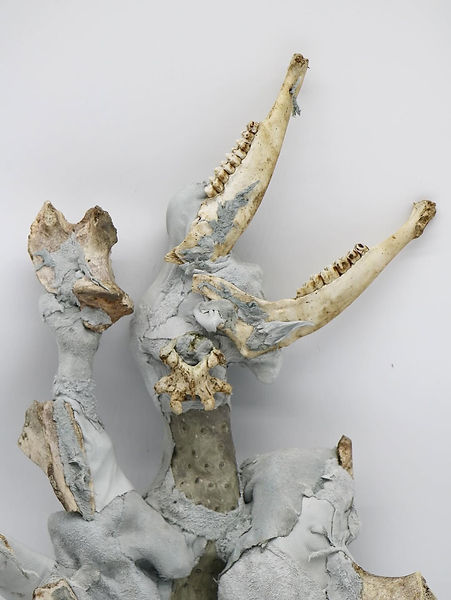
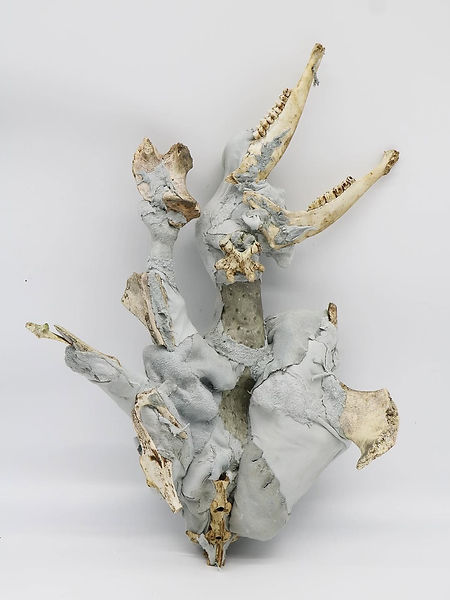

Feticcio Antico della Cascata. An ancient presence where water, erosion, and ritual converge. A form that listens, absorbs, and endures.
SELECTED CURATORIAL TEXT
The wound as passage
In Nera Branca’s work, the wound is never only a sign of damage. It becomes an opening, a threshold through which matter reveals its instability and its intelligence. Fracture is not an end point, but a condition of passage. Through it, bodies decompose, surfaces split, forms mutate, and new presences begin to emerge.
What makes his visual language so compelling is the way it binds together opposites without ever neutralizing them. His forms are violent yet precise, dark yet luminous, abject yet strangely sacred. They draw from the logic of anatomy, the rhythm of vegetal growth, the remains of animal life, and the architecture of hidden shelters. In each case, what appears before us is something unfinished, something still becoming.
Rather than seeking clarity, Branca invites us into zones of ambiguity. His creatures, structures, and ink formations seem to come from a realm where memory, instinct, and decomposition coexist. They carry the feeling of relics from an unknown ecology, fragments of a world in which flesh and landscape are inseparable, and where silence itself becomes a material presence.
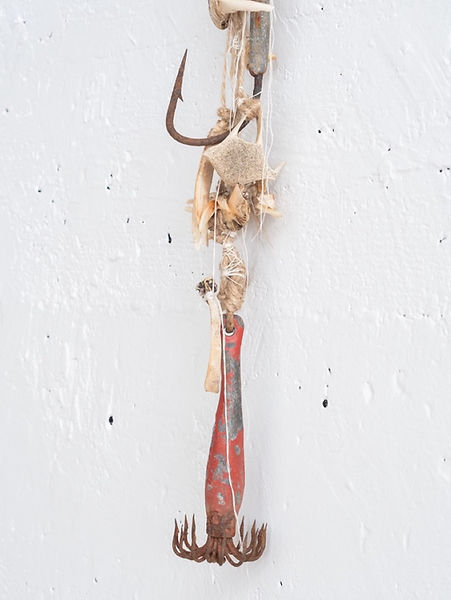
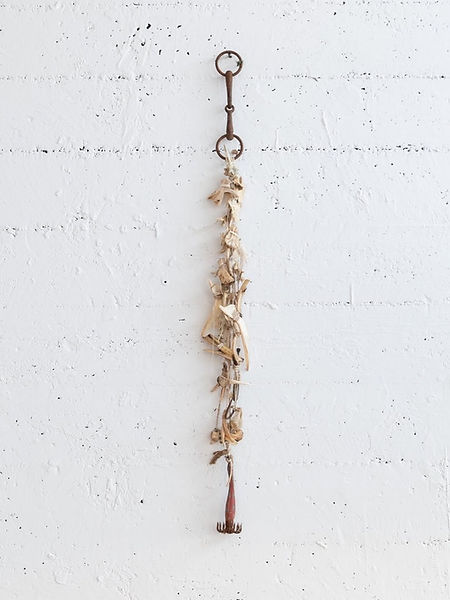
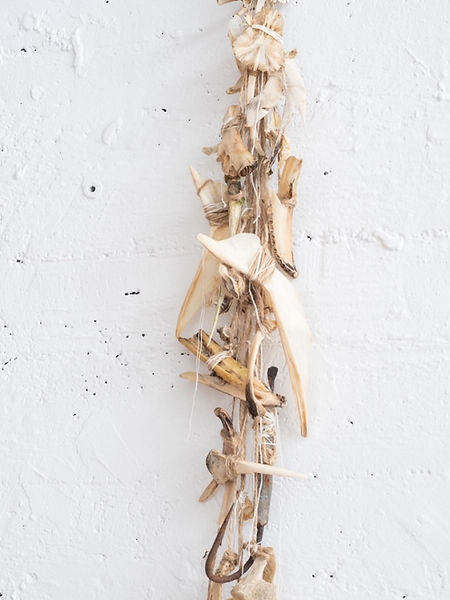
Grappolo d’Ossa I. A fragile chain of remains suspended in space. Matter gathered into a quiet, visceral resonance.
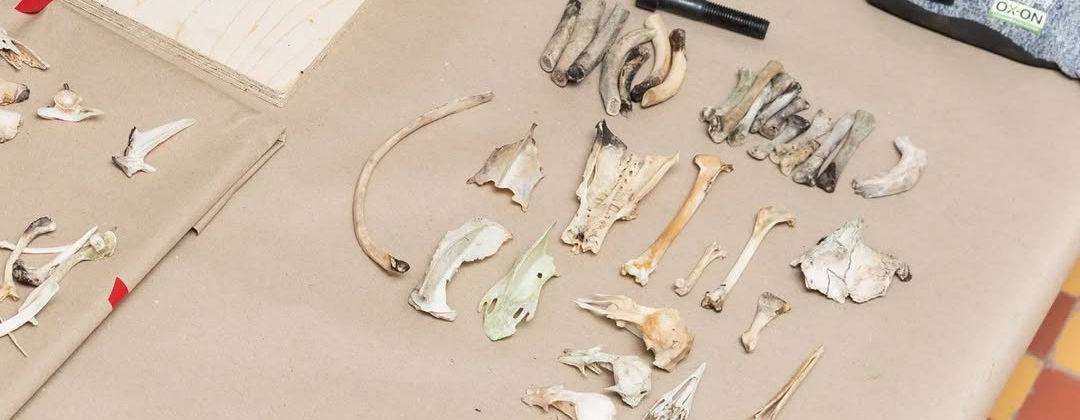
The Migration of Silent Creatures (process). The act of making as ritual. Hands, materials, and time shaping forms into existence.