top of page


Sylvestre Gauvrit
The Shape of Stillness: A sculptural practice led by intuition, vibration, and the five classical elements

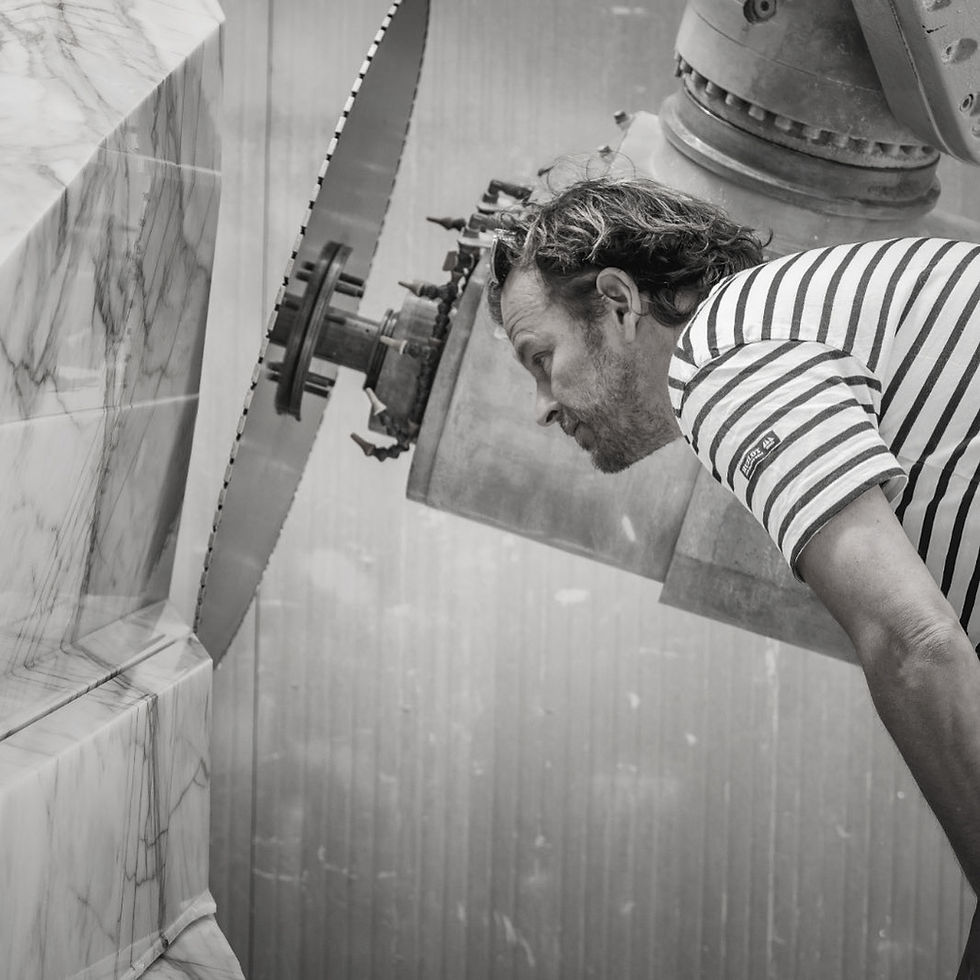
1/2


For Gauvrit, sculpture is not an object; it’s an act of surrender to the invisible forces that move us all.
Sylvestre Gauvrit is a French sculptor whose work captures what is often invisible—vibration, movement, stillness, and spirit. Working with marble, stainless steel, and natural imperfections, he sculpts forms that feel both weightless and eternal. Each piece is a meditation in matter, shaped not through control but intuition. His work channels the five Classical elements—earth, air, water, fire, and spirit—into fluid compositions that hold paradox: silence in motion, grace in fracture, and light within density.
 |  |  |  |  |
|---|---|---|---|---|
 |
BIO
Sylvestre Gauvrit (b. 1977, Moulins, France) is a sculptor whose practice bridges intuition, material, and metaphysics. A graduate of the Academy of Fine Arts in Carrara, Gauvrit lives in the Netherlands and works internationally, creating monumental and intimate works in marble and reflective metals. His sculptures are held in collections across Europe, Asia, and the Middle East, and he is a recipient of the Lih Pao Art Foundation’s Prize for Excellence (Taiwan, 2023) and the Royal British Society of Sculptors’ Bursary Award (UK, 2008).
PUBLICATIONS
Sylvestre Gauvrit’s work has been exhibited internationally in cities including London, Paris, Munich, Dubai, New York, and Amsterdam. His practice has been featured in exhibition catalogs, curatorial texts, and institutional collections. In 2023, he was awarded the Prize for Excellence by Taiwan’s Lih Pao Art Foundation and has received honors from the Royal British Society of Sculptors.
SCULPTING THE ELEMENTS
Gauvrit’s work is a choreography of opposites. He sculpts the solid into something fluid, the heavy into something light, the broken into something whole. Cracks are gilded, flaws embraced. His sculptures don’t deny imperfection—they illuminate it. Each piece moves like a wave held still, like silence made visible. Through stone and steel, Gauvrit reminds us: beauty lies not beyond the imperfect, but deep within it.
bottom of page