.png)
ARTTYCO TALKS
Tycjan invites us into quiet fields of perception where muted tones, soft grids, and layered surfaces unfold slowly, asking us to look again, and then again, in search of what lies beneath.
ARTTYCO TALKS | 11 September, 2025.
EPISODE #12: TYCJAN KNUT
1. Your paintings “invite quiet attention” through overlapping neutral tones and subtle textures. How does this gentle layering shape the viewing experience over time?
T: The thin layers of paint create a subtle, atmospheric depth that invites slow looking. Over time, as natural light changes throughout the day, the colors shift in temperature and tone, revealing new nuances. This gentle layering encourages a quieter, more intimate engagement—viewers might not notice everything at once, but the work gradually unfolds, rewarding sustained attention

2. You work without sketches or predetermined plans, letting compositions emerge intuitively. Can you describe a moment in the studio when the painting surprised you and led you down an unexpected path?
T: I usually work on multiple paintings at once to maintain momentum when I enter a strong creative flow. While I don’t begin with a fixed plan, there’s often a loose concept that starts to form after the first few layers. What keeps me painting is exactly this unpredictability—I’m always surprised by where the work takes me. Over time, I’ve come to expect the unexpected. That moment when a painting suddenly shifts and opens up a new direction—that’s what makes the process meaningful to me, more than any fixed outcome
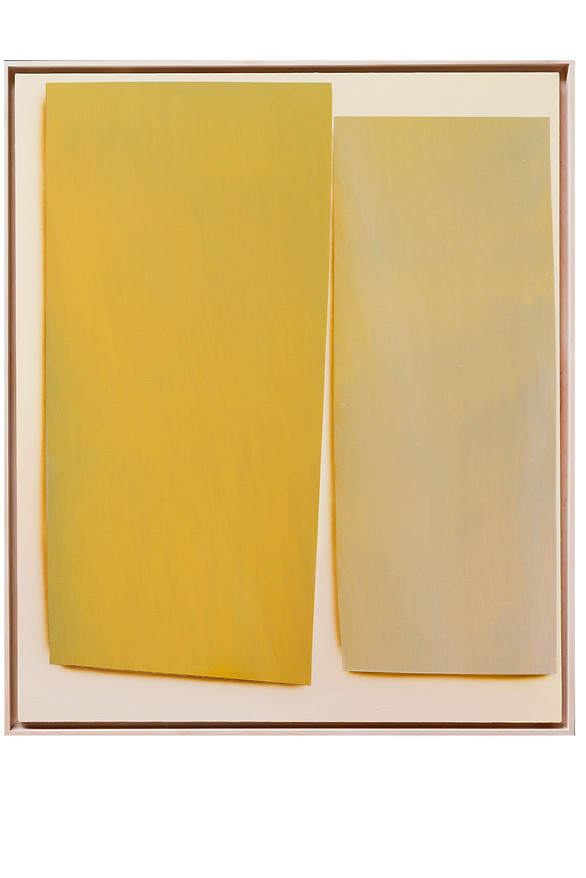

3. Your pieces balance structure and softness echoing both architectural clarity and organic depth. How do you navigate that tension between order and fluidity in your process?
T: The process feels almost sculptural. It starts fast uncontrolled, full of dynamic changes then gradually slows as I introduce restraint. Interestingly, I often begin with what would traditionally come last: the gradient or structure. Only afterward do I build the background around it. It’s a kind of reversal working backwards which helps the figure emerge in unexpected ways.
I always work in series, and the decisions I make are shaped by the dialogue between at least ten paintings at once. Usually, one series leans more toward modernist geometry, structured and precise followed by a freer, looser body of work. This shift keeps the process alive and responsive, allowing each series to question or undo the logic of the one before.

4. You explore how “surface can become space” and how perception shifts with patience. What do you hope viewers notice if they slow down and spend time with your work?
T: I often build a sense of light direction into the painting, carefully considering how the eye will move across the surface. I pay close attention to this—sometimes even observing how people look at my work, tracking their eye movement to see if what I intended actually comes through. Most of the time, it works—but not always, and that’s part of what keeps it interesting.
What matters most to me is that viewers bring their own way of seeing to the work. I hope they give it time, because the contemplative element in my paintings can easily be missed in a busy gallery setting. With patience, the surface can open into something more spacious—a slow shift in perception that can’t be rushed.


5. Your practice is rooted in patience, unfolding slowly for both artist and viewer. How does that meditative pace influence the final atmosphere of your paintings?
T: Patience is something I’ve always aspired to, but it’s never come naturally so it’s a bit of a paradox in my practice. I work very intensely, often with a sense of urgency. The process is full of tension, constant movement, and problem-solving. And yet, the paintings themselves often carry a meditative, peaceful atmosphere something I rarely feel while making them.
That stillness only arrives in a short final moment, just after the painting is finished. It’s a fleeting sense of clarity and calm for me, that’s the reward. Then I move on. I don’t really look back at finished paintings. The focus shifts quickly to what’s next, and the tension begins again.


