_edited.jpg)
ARTTYCO TALKS
Nina Ulrich reflects on how movement, gesture, and transparency shape her layered, unframed works—inviting viewers into a space of quiet discovery and continuous transformation.
ARTTYCO TALKS | 29 Octubre 2025
EPISODE #16: NINA URLICHS
1. Your work draws on dance and theater to express the gestures of the human body. How does movement shape the visual language you’ve developed?
N: The movement of our bodies, or only our gestures and or face is always my inspiration. The expression of our moods and sentiments goes through our body and is readable like a story and even captured by ou unconscious. So these stories you cans see also through my drawings and paintings.

2. You describe your practice as reflecting “a perpetual life cycle” of appearance and disappearance. How do you channel that theme into materials, layering, and composition?
N: I always searched for transparent layers in my paintings. Appearance and disappearance is a main challenge for my collages. Often i hide some details with layers, and often they come out again, but softener. Very early i started to use the transparency of papers in my work to create deeper surfaces, from where the drawing and shadows can show up again.
My art is for a public having time to show longer to the work. Sometimes details are coming to your eyes after years and you can see it often with a new mind and regard.


3. You incorporate transparent layers—paper, fabric, cyanotypes—to create atmospheres of shadow and light. How do these materials affect the emotional or spatial experience of your work?
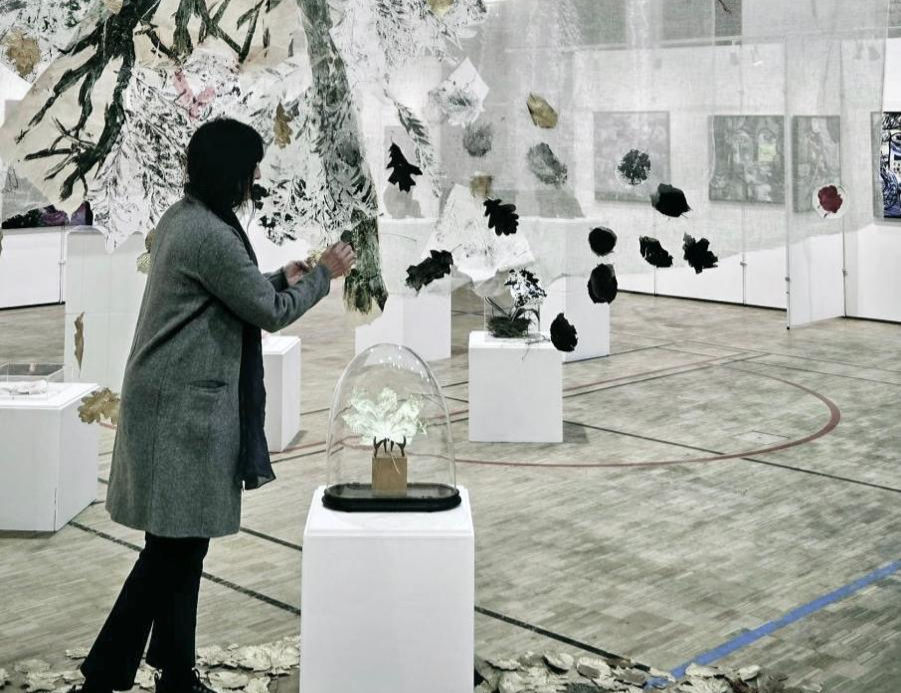
N: The collages and layers of paper and pvc creates often an visual or optical effect. While passing in front of the artwork, your eyes captures different layers and the movement of your body changes the perspective permanently, and so our look. Every time it is a new experience, especially for my bigger installations, where multiple layers creates a theatrical scene.

4. Recent pieces feature red and black lines that extend beyond the canvas like maps or horizons. What do these lines signify, and how do they help guide the viewer?
N: The red line in my works are either the first step, the first draw on white paper on canvas. it helps me to start and to construct a horizon behind my collages. Sometimes it is also the last drawing on my work. it is a line who completes a drawing. Often i use it as a kind of wind or air blowing through my work. A silent movement, coming out of the frame. These red lines are also readable like our roadmaps. you can follow the with your eyes, as a guide.


5. Your wall installations are deliberately unframed, letting forms extend into the surrounding space. How does removing the border influence the viewer’s sense of memory, identity, or openness?
N: My installations are unframed, as some smaller artworks too. I like them to be continued in your mind, open for any creative thinking. Also the installations are made for special spaces and surrounding. They are changeable and there is the possibliliy to adapte to other spaces, to get bigger and bigger, or the get into corners.... They are hanging also free in the room, to be seen recto and verso.
Some smaller artworks are unframed because you can combine them with other works, so they become diptychons, triptichons or more multibles. Some works could go on walls of 20 meters of more, each work beside the other, where the movement of bodies are ongoing like a wave. And i think that this open form of art creates also an open mind, for the artist and for the public, so see and show something where everything is possible.