
ARTTYCO TALKS
Alva invites us to drift between worlds—where glass and steel echo the rhythms of water, and sculptural forms become meditations on movement, memory, and the ocean’s pull.
ARTTYCO TALKS | August 2, 2025
EPISODE #5: ALVA GALLAGHER
1. Your work captures both the ferocity and serenity of the ocean in materials like glass and bronze. How do you translate those contrasting aspects—power and stillness—into sculptural form?
A: The ocean has always been a profound source of inspiration for me; it’s vastness, it’s rhythm, its ability to shift from calm to chaos in a heartbeat. When working with materials like glass and bronze I’m drawn to their dual nature. Glass is both delicate and sharp, transparent yet strong; bronze is enduring, yet it can be shaped into flowing, fluid forms.
To capture that contrast I focus on movement; how water pushes, pulls, lifts and settles. In glass, I use techniques that stretch and fold the material while it’s molten, freezing that motion into place. With bronze, I often work from wax models that are sculpted to reflect tidal flow or wind on water, then cast to preserve that gesture. It’s about holding a moment. Whether it’s a crashing wave or a lull between tides and allowing the material to embody that emotion. That balance of power and stillness is at the heart of the ocean and I try to let it speak through every curve and contour of my work.

2. Many of your sculptures “freeze” fluid moments—like tides, waves, or breath—into solid materials. What draws you to capturing these fleeting, transitional states?
A: I’m deeply drawn to the in-between moments. Those fleeting states where energy shifts, where something is neither arriving nor leaving but suspended in transition. Growing up on the Atlantic coast, I’ve always felt the pull of the sea’s rhythms: the rise and fall of tides, the pause before a break, the stillness after it recedes. These moments are ephemeral yet they hold immense emotional weight.
By “freezing” them in materials like glass or bronze, I aim to make the intangible tangible. To capture the breath between movements, the quiet intensity of change. There’s something poetic about using solid, enduring materials to hold a moment that would otherwise disappear. It becomes a meditation on time, transformation, and the quiet power of nature’s cycles.

3. You’ve exhibited both intimate wall pieces and large-scale public installations like Pulse and Ascend. How does scale—and public engagement—affect your artistic vision?
A: Scale shifts the way a work speaks. With more intimate pieces the experience is personal. Viewers often draw close, observing fine details, textures and the subtle play of light. These works invite quiet reflection, like listening to a whisper. But with large-scale public installations, like Pulse and Ascend, the energy changes. The work has to hold space. It becomes part of the landscape, interacting with light, weather, movement and most importantly, people.
Public engagement adds a new layer to the piece. It’s no longer just about my perspective, it’s about creating something that invites dialogue, emotion and even memory in others. I consider how people will move around the work, how it might shift their sense of space or stillness. Whether small or monumental, the core remains the same: capturing the natural forces that shape us, and offering a moment of connection, either personal or shared.

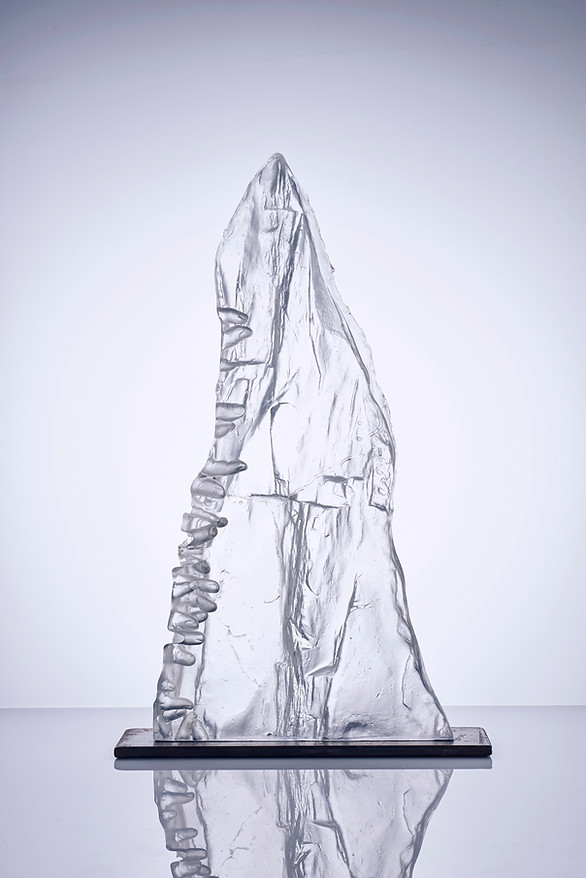
4. Your Icescapes series reflects the relationship between sea and self, examining internal change through natural cycles. How do ice and water become metaphors for your own emotional or experiential journey?
A: For me, ice and water are powerful metaphors for the inner shifts we all experience. How we hold, release, adapt and transform. Water is constantly moving, shaping its surroundings, while ice carries this beautiful tension: it’s solid, but always on the edge of becoming something else. That idea of transition, of stillness that contains movement, resonates deeply with my own emotional landscape.
In Icescapes, I explore that space where strength and vulnerability meet. Ice reflects resilience, but also fragility. It can fracture under pressure or melt with warmth. Those qualities mirror times in my life where change felt both quiet and immense, like a tide slowly turning beneath the surface. By sculpting these forms, I’m both representing nature and tracing our own evolution, using the language of sea and ice to express the emotional undercurrents that shape who I/we are.


5. What role does elevation or verticality play in your sculptural language?
A: Elevation and verticality are central to how I express movement and transformation in my work. They allow the sculptures to reach, physically and metaphorically, beyond the surface. Whether it’s the upward pull of a wave, the rise of breath, or the quiet force of tide and wind lifting and shaping form that vertical motion speaks to a sense of ascent, of energy moving through space.
There’s also a sense of weightlessness I often try to capture, especially when working with heavier materials like bronze. By drawing the eye upward, I invite a moment of pause and contemplation, as though the piece itself is suspended in a state of becoming. Verticality becomes a way to evoke transition, elevation of the self, and connection between the grounded and the ethereal. It mirrors both the natural world and the inner shifts we navigate.


