
ARTTYCO TALKS
Adrian Guerrero reflects on the relationship between thought and form, silence and perception. He shares how philosophy, material, and process converge in his practice.
ARTTYCO TALKS | 04 February, 2026
EPISODE #23: ADRIÁN GUERRERO
1. Your work moves between philosophy and matter, between idea and object. How do you translate a conceptual reflection into something tangible? How does thought take form in your process?
A: Translating a conceptual reflection into something tangible involves a process of introspection and creativity of constantly bringing a sense of wonder about life into the present, into my everyday experience.
First, I try to better understand the idea I want to express.
Then, I unfold that idea into materials and techniques that resonate with the reflection, allowing form and content to intertwine. In this process, it’s very important to me that the work remains feasible within my own possibilities — both personal and material.

2. You’ve described your work as exploring perception and spatiality. What role does the viewer’s physical presence play in completing the meaning of a piece?
A: I like this question because, without the viewer, no artwork would make sense. Personally, I enjoy transforming abstract thoughts into visual experiences, always seeking for the final result to create a dialogue between the idea and the viewer through an object: a piece.
I appeal to the perception of those who engage with my work, which often resonates differently for each person. It’s precisely within those diverse perceptions that my passion for this process lies each person sees as they are. That’s where my love for abstraction comes from; I believe abstraction allows greater openness for the viewer, unlike figurative work, which tends to immediately close interpretation toward what it intends to represent.
Reflecting on this, I realize that my work follows a path of abstraction (idea) – realization – material abstraction (the work) – and the viewer’s interpretation.


3. Materials like ceramic, bronze, and copper carry both fragility and permanence. How do you choose which material to work with, and what does each allow you to express about time and transformation?
A: I always choose my materials based on my ability to create , meaning what I can access and what I know I can execute well; that’s the most important thing for me. From there, I consider it essential that the material I use becomes an intrinsic part of what I wish to convey.
Ceramics came into my life through my father, and from there, my personal creative path began. I’m constantly learning from this craft, which is often unpredictable. Sometimes, when a piece must go into the kiln, it can get damaged this has taught me to be resilient against frustration. I’ve learned to try again and again, sometimes three or four times, to achieve the result I’m seeking.
Ceramics brought many challenges, which led me to experiment with other crafts and materials. At first, I did this without a clear intention regarding the work’s message, but as I became familiar with them, I realized that each material’s inherent qualities could contribute to the work depending on how they’re used.
Now, I choose materials and techniques based on what I want to express. That first stage of experimentation was very important for me, and I continue exploring new materials. The more I learn about them, the richer my artistic language becomes.
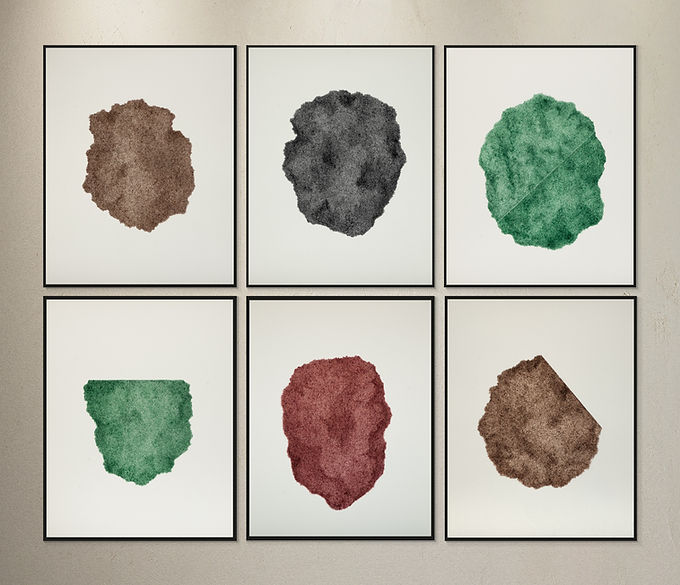
4. In your work, ideas become forms rather than representations. How do you approach that transformation without falling into literal interpretation? What keeps the idea alive through matter?
A: Falling into literal interpretation is one of the risks many of my pieces face. I believe there’s a limit there and I enjoy navigating it. When obviousness becomes too strong, I try to abstract further; however, there are times when certain works need to be quite literal.
To my surprise, the collective perception often gives these pieces many more readings than I initially imagined. This is exactly what I mentioned before: human perception is open and infinite and that’s why I’m passionate about art.


5. Your pieces often invite a quiet, reflective encounter. What kind of experience or awareness do you hope to awaken in those who stand before your work?
A: Silence is often my starting point — if not always — and from it, reflection emerges. Some of my pieces may appear as simple doodles or distorted forms to some people, but it’s precisely when you take the time to truly look at them that, from my perspective, they begin to provoke, to move, and to invite contemplation.
Many of my works are not necessarily intended for all audiences; I believe there must be a genuine interest in contemplating them, without expecting them to captivate at first sight.
Ultimately, what I seek is for art to create a personal connection to offer an opportunity to look within. There’s a phrase by Jesuit Javier Melloni that perfectly captures what I aim to evoke with my work:
“The gaze with which we look
Is the one that looks back at us
From what we see.”
To close, I’d say that Silence is one of my guiding principles in everything I like to dwell in the spaciousness of silence.

