
ARTTYCO TALKS
Cecil explores the circle as a language of connection, movement, and meditation, where strength and fragility coexist in her sculptural practice.
ARTTYCO TALKS | January 26, 2026
EPISODE #22: CECIL KEMPERINK
1. How did the circle first become central to your artistic language, and what
keeps it so vital in your practice?
C: The very first circle—now a cornerstone of my artistic journey—emerged upon the potter’s wheel. As a cylinder spun before me, I placed a needle lightly atop, and a perfect circle revealed itself; this simple geometry utterly enchanted me.
From then on, the wheel became my canvas for creating countless circles, each one spun into being with joyful fascination. I adorned my wheel-thrown vases, bowls, and cups with these concentric forms, letting them dance along inner and outer surfaces. Eventually, I felt the urge to move beyond the wheel’s limits, craving the freedom to craft larger-scale works.
This search led me to new techniques—another realm opened as I blended my background in textiles with clay through bold experimentation. Combining diverse fabric traditions with sculpted earth, I discovered inventive ways to form circles by hand, letting each step build upon the last, shaping a distinct style of assemblage.
Today, my sculptures are the result of this continual experimentation—each piece emerges from a dynamic process of building and connecting elements. The circle remains central: as a symbol, it holds unmatched strength—both physically and metaphorically, embodying unity, connection, and endless possibility. I am continually drawn to the elegant simplicity of its form: organic, powerful, infinitely looping, and undeniably gentle.

You often speak about the connection between body, material, and
energy. How does your background in dance influence the way you shape,
assemble, and even move with your sculptures?
Dance has always been essential to me. Since childhood, I’ve immersed myself in all kinds of dance classes and styles. For a time, I dreamed of becoming a professional dancer, but that path changed when I wasn’t accepted into the dance academy. Yet, dance never left me. For me, it is pure freedom—the act of being myself in motion, shaping space with my body.
It’s a way of expressing my inner world, creating forms, tracing lines. When I think about it, it’s remarkably similar to sculpting. In my studio stands a large mirror where I practice alongside my sculptures—where I explore new movements to weave into my art. I study the body’s curves, the infinite possibilities of motion, and the flow between inside and outside—how a gesture begins from deep within.
This dialogue between motion and matter fascinates and inspires me. Even when a sculpture seems “finished,” it isn’t truly complete. That moment marks a new beginning: the encounter between body and artwork. How do they interact? How does our duet unfold?
By dancing with my sculptures, I discover new layers—different presences, unexpected meanings. Together, we move, connect, and respond to one another, exploring where boundaries blur and creativity breathes.

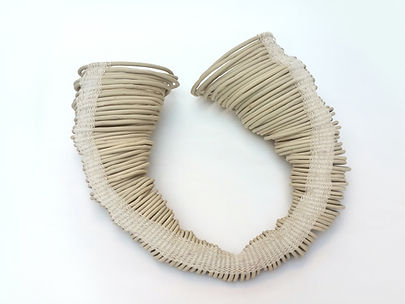
3. The act of connecting thousands of ceramic rings feels both meditative and
physical. What role does repetition play in your process — is it a discipline, a form of meditation, or a dialogue with time?
C: It’s truly all three. For me, it creates a meditative state—a quiet atmosphere I need to enter, allowing me to step out of my head and feel grounded, connected to the earth.
It is also a discipline, much like knitting, walking, or any handmade practice that demands patience, attention and rhythm. Repetition becomes a kind of breathing pattern, a pulse that shapes the work as much as the clay itself. Time, too, plays its paradoxical role—both essential and irrelevant. When I’m deep in the flow, time disappears entirely.
Yet the process itself consumes time in vast amounts. Each piece requires slow stages of drying and firing—sometimes more than eight rounds in the kiln. It can take months before a sculpture reveals its final presence, both tangible and emotional.

4. Your sculptures invite touch, sound, and interaction, blurring the line between object and experience. What do you hope happens in that encounter between artwork and viewer?
C: I want to create a sense of connection, spark curiosity, and encourage people to reflect on how they communicate with others.


There’s a tension in your work between strength and fragility, permanence and movement. How do you navigate this balance when working with something as grounded yet delicate as clay?
C: I’m drawn to contradictions; they’re everywhere, essential and inseparable. Opposites that depend on one another — revealing, challenging, teaching.
Is vulnerability a limitation or a strength? Like us humans, endlessly fragile yet undeniably strong.

