
ARTTYCO TALKS
Laurens invites us into luminous grids of stillness and precision—where repetition becomes meditation, and light carves out space for reflection, presence, and quiet depth.
ARTTYCO TALKS | August 23 , 2025
EPISODE #9: LAURENS MOSTERT
1. Your creative journey began with a fascination for the Dutch ZERO movement. How does that minimalist ethos still shape your approach in the later pieces?
L: Even though my style diverted from “absolute minimalism” as I call it, I can still see the traces in multiple ways. In composition, colour setting, (modest) use of materials and general visual information. I also try to make sure that the process and development over the years but also within one piece happens in small steps.

2. You meticulously fill grids with ink one square at a time under a magnifying glass. How do you balance the meditative concentration this demands with your intuitive, analytical rhythm?
L: I try to empty my mind as much as possible. Some days this is easier than others but it always finds it’s way in a harmony.
%20680x95x3cm%20paint%20and%20ink%20on%20woo.webp)
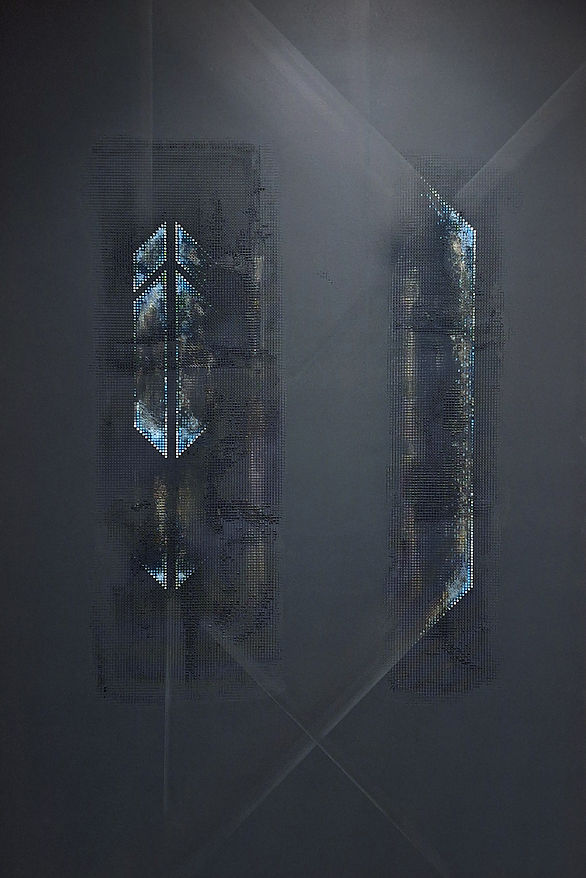
3. You describe your process as both “intuitive and analytical” and aim to render the great in a modest way. How do you practice restraint while still creating something visually impactful?
L: One characteristic I inherited from my mother (who is also an artist) is that I can marvel at something minute, a detail of a detail and see a world in that. So in a way I don’t feel that I am holding back. The image that is there contains a repetitive endlessness. It is dramatic but in quite a silent way.

4. You named an earlier series ‘LUMINA’ meaning ‘lights or cavities,’ and your works incorporate literal cavities in the grid. What does this contrast of light and emptiness reveal about your artistic visions
L: I often read in Taoist scripts and stumbled upon a passage where it is mentioned that the Absolute is the Relative. More and more I find that working on my art is broadening my horizon and that has an effect on my life outside of a piece and later that is put back in a painting. So the two things influence one another. The opposite of light/dark, empty/full etc, don’t feel like opposites to me, more as the same thing, or maybe as two things that meet each other on a circular movement.
%20380x95x3cmpaint%20and%20ink%20on%20wo.webp)
%20280x95x3cmpaint%20and%20ink%20on%20wo.webp)
5. Your work is rooted in patience, concentration, and the interplay of control and chance. How do you know when a piece is finished, and what does that moment feel like given the precision involved?
L: “You finish a piece of art by looking.” Apparently that is a quote from Karel Appel. I like that thought but then again when you consider a piece to be finished and you show it to the public, something else happens to it. I never know why a piece is finished. Often I come back to it a few times when it’s close, sometimes make a few adjustments, careful not to overdo it and at a certain moment a feel enough harmony to say : it’s done!


